Potential research projects involving insect community ecology
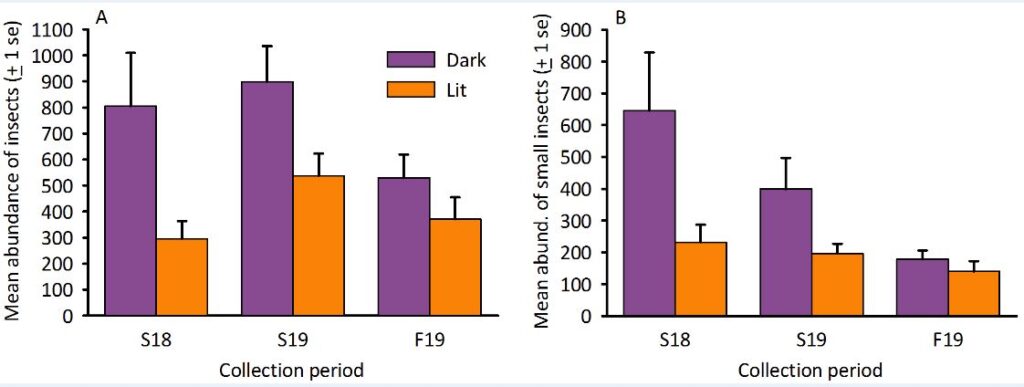
My research interests in general are in the dynamics and biodiversity of insect communities. I have studied tree-hole communities (water-filled rot holes in trees in which mosquitoes and other aquatic insects live), stream macroinvertebrates, pollinator communities in parks, invertebrate communities in prairie restorations, insects on decomposing carcasses, and nocturnal insect communities affected by light pollution. For the next few years, I am focusing on monitoring insect communities in streams following a fairly disruptive stream restoration and in fields that are being managed for native vegetation. Students interested in working on stream aquatic insect communities can find opportunities in the spring semester and students interested in native prairie restoration insect communities can find opportunities in the summer and fall.
Projects on education research and biodiversity literacy
I am also engaged in discipline-based education research (DBER). Most recently, I have studied the impact of using online insect identification resources and open-access data portals on biodiversity literacy in an entomology course.
Check out my work on Google Scholar or Research Gate.
Project ideas
I am currently interested in more applied research projects, with the first two projects I am currently working on:
- In spring semester, I primarily conduct research with students on the impacts of stream restorations on aquatic macroinvertebrate communities. This involves a combination of fieldwork in local streams, sorting samples in the laboratory, identifying insect specimens, and analyzing new data along with data collected over the past few years by many other students.
- In the summers and fall semester, I primarily conduct research on the impacts of a native prairie restoration project on invertebrate abundance and diversity. This project also takes advantage of past data and tracks communities over time. We primarily use digital macrophotography to document presence of invertebrate species.
- I am open to mentoring students interested in literature-based explorations, which would fall under BIO370: Directed Reading. Those projects would likely be explorations of ecological topics of interest to the student, in consultation with me.
- Determining the efficacy of various assessment and educational tools and activities. Biodiversity literacy has been an interest of mine recently. Species and biodiversity literacy are pedagogies that can increase understanding and appreciation of local and global biodiversity.
- I am open to collaborating with students on their own student-driven projects. If you have an idea that involves applied ecology of insects or biology education research, please contact me – I am happy to discuss and brainstorm ideas with you.
Criteria and expectations for collaborative research with Dr. P.
The insect projects are largely, but not always, collaborative. They involve fieldwork and are dependent upon the weather. I don’t allow students to conduct fieldwork solo, so this would require at least a pair of students, as I won’t be going out on every field trip. Typically, I spend a lot of time in the field with my students early on, training them and making sure protocols are well executed. As the semester proceeds, students do more of the work independently, at least until it is time for data analysis. These projects requires an interest in insects and/or ecology, and I generally ask for at least BIO114 or BIO116 as a prerequisite, and a strong desire to conduct fieldwork. ENV201 is also an adequate prerequisite.
